When out camping in Australia I was often asked how I knew sooner than everyone else when to prepare for sudden downpours and in the surf town I lived in I was often asked the upcoming surf weather. My answer always gave credit to the amazing abilities of the Laughing Kookabura.
The orchestra of multiple Kookaburras laughing has been used in nearly every movie with a prehistoric jungle to flourish with unusual bird sounds, though, once listened to with understanding can give a more accurate forecast of the weather than the weatherman on tv.

There is a part of Australia that has stayed with me since moving to France and that part is the nature, the feel of the country, the memory of the animals has such a strong imprint on my soul. I wanted to give light to this wonderful bird, so I painted this front on portrait of a Kookaburra from Victoria, Australia. I got to know the Kookaburra really well, it was my wake up call to the intelligence and abilities of animals. After really connecting in with this bird, my animal communication flourished, across the board. I would love to encourage deeper listening and attention to the animals around us and I would love it if my discovery that the legend of this bird is true would cause more people to turn to nature for important emergency weather warnings that the weatherman may not be in the know about, of which there are many in Australia. I would even be happy if my translation of their call could inspire scientists to study further into this bird’s call and shine a light on the declining numbers.
I first started being interested in the legend of Kookaburra’s foretelling the weather when living in NSW, when I was surrounded by many families of kookaburras. I started off guessing the different sounds meaning and checking against weather forecasts and actual weather. This helped refine the translation over a few years of stopping what ever, where ever I was and listening intently to the call. Thank you to my family and friends who tolerated having to constantly stop in mid-sentence, so I could hear the call!

Here, I share with you some of my observations:
The 3-5 day forecast is done in the morning and occasionally through the day and repeated every morning until the morning of the weather.
When the tree availability and population of the kookaburra allows it, the families form a large roosting circle.
The call is done first by the group closest to the direction the weather is coming from. If the weather is strong, it will be repeated and more kookaburras join in the melody. if the harmony comes together on Kack- then it is rain. If the harmony comes on the Kook, it is wind.
The call is then copied by each family group around the circle until it comes back to the first group. They repeat the same call in the morning of the actual wet or windy weather, it does the loop, however, the song is shorter and doesn’t need a second go around. Slight variations in the call from day to day were noted.
Occasionally, kookaburras in the chorus will go quieter or stop whilst the beginner continues, then they begin again- the pauses seem to be markers of days passed. The loudness is linked to the intensity of the weather.
For example; a long quiet kack kack is drizzle, a loud and defined Kak kak is heavy rain.
After moving to Victoria and then camping up and down the east coast of Australia, I noted that in their short weather forecast, the further up the coast you go, the earlier the prediction gets. In NSW, it is around 15-20 minutes before the weather’s arrival, in Victoria it is around 2 minutes or less.
In the short weather forecast, just before the weather starts locally, 1-3 Kookaburras give a warning. When abrupt Kooks start, there is wind gusts within minutes. Heavy rain is given a quick urgent warning up to 30 minutes before, starting more suddenly and at full volume.
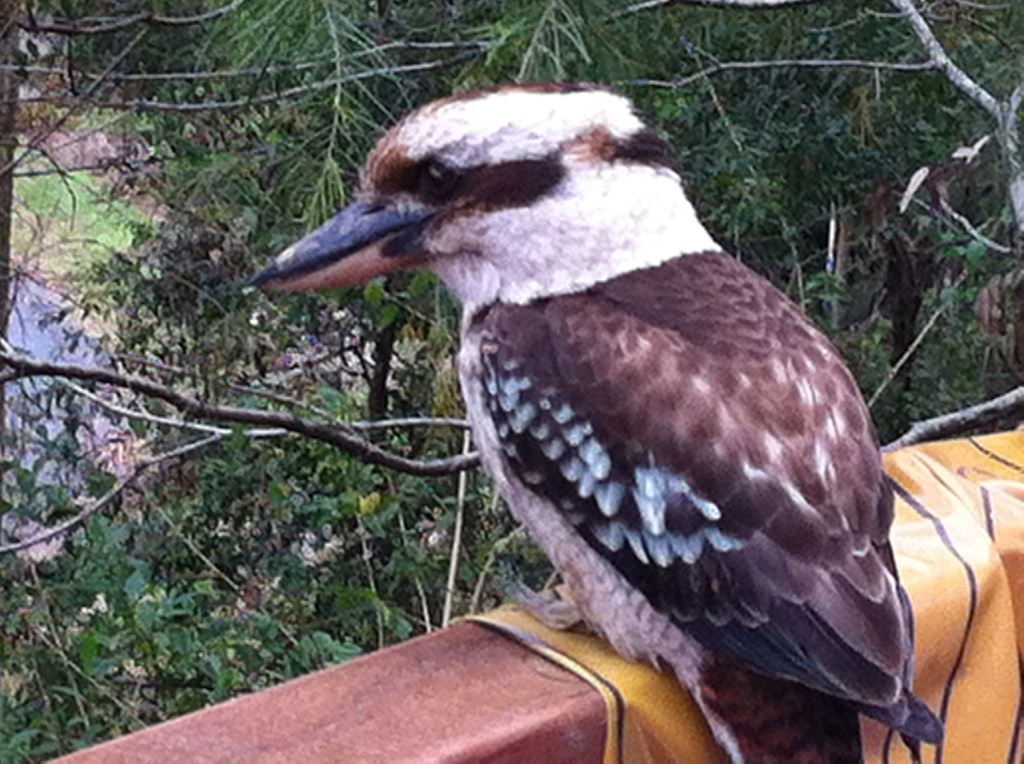
Kak kak – rain predominately rain.
Kook kook- , breeze or wind.
Soft Kooo Kooo- mild, sunny weather.
Kookaburras make other calls that are not forecasts. These can be mating, territorial or even teaching sessions for the young kookaburras. Currently legend says Kookaburras tell the weather, yet that is all. What little studies have been done on them say that their call is territorial.
This translation is for the Laughing Kookaburra (Dacelo novaeguineae), one of 5 tree kingfishers native to Australia, found on the East coast of Australia.
Here is a silly poem that may help remember the very basics:
If you start listening to the kookaburras cue,
You’ll know the oncoming weather too,
Carrying on with a kak
Then there soon be rain falling on your back,
More on the kook sound,
then more wind is about, I’ve found.
Now you have started listening to the kookaburras cue,
You know the oncoming weather too.
Article and artwork by Tina-Renae.
References:
 Tina-Renae Art
Leave a comment